

15 June 2026 · Apollo View Modular
Align is out
Align is out — sub-sample timing, broadband phase, a tunable allpass and a full mid-side output stage in one plugin. Get your kick and bass to agree, or get creative with delay and phase.

Every electronic producer fights the kick and the bass for the same forty hertz. Every engineer mixing a multi-miked kit fights a quieter version of it. Align treats both as what they are — a timing and phase problem — and brings every kind of alignment, plus a full stereo and mid-side output stage, into one plugin.
If you make electronic music, you know exactly where this lives. The kick and the bass want the same forty hertz, and they will not both have it. Solo them and they're huge. Sum them and the low end goes soft, or uneven, or you push the bass up until the whole track booms. So you reach for the sidechain, clamp a compressor on the bass, key it off the kick, and duck the bass out of the way every time the kick lands.
It works. It also throws bass energy out of the mix on a rhythm, pumps the groove around, and never asks why the two were fighting in the first place.
Most of the time they're fighting because they're not lined up. Their low frequencies arrive slightly out of step and partially cancel on the sum — and ducking one out of the other's way is treating a phase problem with a volume tool. Get the timing and the phase right and the two reinforce instead of cancel. The low end gets louder and steadier at lower faders, and you need far less ducking, sometimes none, to keep it clean.
You don't have to be making house records to need this
If you record, you've met the same problem wearing a different hat. A multi-miked drum kit is a phase minefield: kick in against kick out, snare top against snare bottom, close mics against overheads and room mics that arrive a metre or two late. A DI combing against the mic'd amp. A lav and a boom on the same line of dialogue. None of that is a creative choice — it's physics putting the same sound at two microphones at two different times, and it smears the result.
That's a technical correction, and Align does it precisely. Slide the late mic forward by sub-sample amounts until the transients stack; flip a polarity; rotate the phase until the kit snaps into focus. You can even read the shift in metres and feet of mic distance, because that's literally the thing you're correcting.
The whole job, not a third of it
Here's what actually pushed me to build it. I kept ending up with three plugins open on one stubborn kick — and the pieces already existed, they were just scattered across single-purpose boxes. One tool does sub-sample timing and nothing else. Another does broadband phase rotation and stops there. A third is a single all-pass and that's all it knows. Three problems, three boxes, three windows, for one job.
Lining up two signals is one job. I wanted one plugin that did the whole of it:
- Sub-sample time shift — a Coarse ±30 ms control and a Fine ±100 µs control, summed. Read it in milliseconds, samples, or distance.
- Broadband phase rotation — one bipolar dial, −180° to +180°, through a linear-phase Hilbert. 0° is pure pass-through; ±90° is a true Hilbert; ±180° is a clean polarity flip; everything between is continuous, no stepping. Magnitude stays flat at every frequency — phase, not tone.
- One surgical all-pass — frequency 20 Hz–20 kHz, Q 0.1–10, first or second order, and polarity, for when the cancellation lives in one band rather than across the whole spectrum.
- Polarity invert — a hard 180° flip on its own switch, where you'd expect it.
It nulls bit-exact at its neutral settings, too. Until you move a control, Align is not touching your audio — not a dither of difference. That mattered to me, so it's gated in the tests and it stays that way.
Stereo, mid-side, and a real output stage
All of it runs in full stereo or mid-side, with a Link toggle. Linked, both channels move together. Unlinked, every control — time, phase, all-pass, invert — is independent per channel or per bus, so you can align a stereo pair, or rotate the side without touching the mid. And the live phase curve draws both sides at once when you unlink, red and gold, so each move reads at a glance against the other.
It all lands in a proper output and imaging stage, so you commit the corrected signal without reaching for another plugin:
- a Mono Maker that folds the low band (20–500 Hz) to the centre — exactly what you want once the kick and bass agree;
- a Side Mix for width and mid-side balance;
- Pan and L/R Swap for placement;
- a Mono Mix to check the fold;
- and high- and low-pass filters, two-pole and per channel, to clean the edges.
And it opens doors
I didn't want a tool that could only undo a problem. The same controls that line two signals up will take you somewhere creative — with real units, not a mystery "vibe" knob.
The Coarse control reaches ±30 ms, which is exactly the Haas window: unlink the channels, delay one side by a few milliseconds, and a mono source spreads into a wide stereo image. In mid-side, you can rotate the phase of the side independently of the mid — reshape how the stereo field sits without ever touching the centre, so your kick and lead vocal stay rock-solid in mono while the sides breathe. And because broadband phase rotation moves where energy sits in the cycle without changing the spectrum, you can reshape a transient — push a kick's peak forward or tuck it down — by phase alone, no transient designer in the chain.
Same honest controls. You're just pointing them at finding a sound instead of fixing one. Align stays focused on alignment, and gives you real numbers the whole way.
It pairs with DeltaScope
This is the loop I always wanted, and Align is the piece that was missing:
- DeltaScope shows you the problem — overlay the kick and bass, subtract them, watch the low end cancel.
- Align fixes it.
- DeltaScope confirms you didn't break anything else.
Put DeltaScope on the bus in delta mode, dial Align until the difference drops into the floor, and you can watch the cancellation disappear. The two were built by the same person to sit next to each other, and it shows.
The details
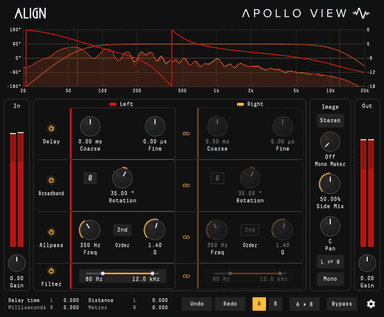
ALIGN
Line it up
Align is out now — VST3, AU, macOS 13 Ventura or later, Intel and Apple Silicon native. One price, no introductory-this or limited-time-that. One licence key, activated locally in the plugin: no account, no dongle, no iLok.
There's a full demo so you can try it on your own kick and bass, or your own drum bus, before you decide — every feature, nothing held back. Windows, AAX and CLAP are on the way.
If you own DeltaScope, this is the other half of that tool. If you don't, the free Scope is still the easiest way to see what I mean.
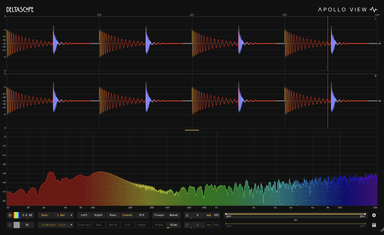
DELTASCOPE
See the difference
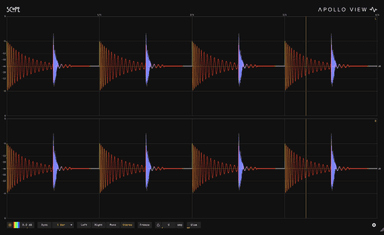
SCOPE
See the signal
Load it up, get your low end to agree, and tell me what's missing.