

14 June 2026 · Apollo View Modular
Scope and DeltaScope reach 1.0
Scope and DeltaScope hit 1.0 — a faster GPU spectrum analyser, true-LUFS metering, lighter rendering across the board, and a full DeltaScope demo to try before you buy.

When I wrote the last journal entry, I'd just shipped the free oscilloscope I always wanted - and quietly knew it was a 0.9, not a 1.0. It worked. It looked right. But there was a long list of things I wanted to fix, sharpen, and make fast enough that I'd never think about them again. The last few months have been exactly that: head down, no new shiny features for their own sake, just getting both plugins to the point where I'd put my name on the number 1. Both Scope (free) and DeltaScope (paid) are now at 1.0. Here's what changed.
Making it fast
This was the big one, and it's where most of the time went.
The single largest win was moving DeltaScope's spectrum analyser onto the GPU. The curves, the peak-hold lines, the out-of-band dimming and the grid used to be re-rasterised on the CPU every single frame - which, on a large window on a Retina display, was the difference between a stutter and a smooth picture. It's now drawn directly on the GPU. Same look, a fraction of the cost, and it frees the CPU back up for everything else the plugin is doing. If the GPU path isn't available on your machine, it quietly falls back to the old way.
Then there's long-window viewing, which both products share. The scope used to copy the entire visible window of audio out of the ring buffer every frame - around 6 MB per frame, per instance, at a 16-bar window. Now it copies only the audio that actually arrived since the last frame, typically a few kilobytes, and reuses the rest. With several instances open at long windows that roughly halves the scope's CPU use on its own.
A few more, in the same spirit:
- The band filter (DeltaScope) no longer rewrites and redraws the whole waveform every frame, and it now runs on a background worker with a lighter zero-phase implementation so a stretched-out, filtered scope across three instances that used to crawl at ~10 fps now stays at full frame rate, and the old freeze-on-first-toggle is gone.
- The write cursor was quietly repainting both full scope lanes at Retina resolution on every frame. It now repaints only the thin strip it actually moved across - roughly half the display-chrome CPU cost during playback, gone.
- The oscilloscope dropped hardware multisampling (the waveform is already drawn with antialiased paths, so there's no visible difference), and on Intel Macs the analysis workers now flush denormals so quiet passages stop costing 10-100× per operation.
None of this changes how anything looks. It just means the plugins behave on older machines, and when you've got a stack of them open across a mix.
Making it accurate
Performance is invisible when it's right; measurement is the opposite - you stare straight at it. So a lot of 1.0 was making DeltaScope's numbers trustworthy.
- The loudness meter now reads true LUFS - a single, standards-correct ITU-R BS.1770 / EBU R128 measurement of the whole stereo programme, K-weighted continuously the way hardware loudness meters do it, rather than a per-channel approximation. A −23 LUFS reference tone now reads −23.0, full stop.
- The FFT Delta got a lot smarter. Alongside the residual spectrum it already drew, it can now show a magnitude transfer of main against sidechain in dB - so a pure phase or alignment move reads dead flat, while a real EQ change shows its curve. It draws each channel on its own line in Stereo and Mid-Side, so a difference that only affects one side no longer averages itself away. And the whole Delta path now nulls everywhere at once - scope, heard output, and spectrum all share one alignment, so what cancels to silence on screen also cancels in your ears and in the analyser.
- The measurement crosshair now follows your pointer as you move across the spectrum, reports each frequency's Max / Min over a rolling window plus a steady RMS average, and - when you hold Option — snaps to the nearest prominent peak by proximity rather than loudness, so a quiet peak sitting next to a loud one is still reachable.
Making it feel right
The unglamorous stuff that you only notice when it's wrong:
- Every slider now shares one feel. The wheel is velocity-sensitive - one step per notch when you scroll slowly so you can land on an exact value, coarse when you flick - and it's no longer tied to the slider's range, so the wide-range offset sliders stopped leaping by hundreds of steps per notch.
- The spectrum analyser's separate Attack/Release controls became a single Averaging knob that behaves consistently across every FFT size, peak hold now holds before it falls (with an Infinite setting to capture the absolute maximum), and there are proper fractional-octave smoothing controls.
- Showing and hiding the analyser now animates smoothly instead of snapping, the panes resize as one surface, and the labels throughout were lifted closer to white for legibility.
Making it solid
Then there's the work nobody sees and everybody relies on: your settings round-tripping (save and load) exactly, presets loading into an open editor immediately, window sizes restoring as saved, and a pile of edge-case crashes chased down - mono sidechain Delta, re-linking sidechains while audio runs, closing the editor mid-analysis. I also hardened the lock-free hand-off between the audio and display threads against a subtle memory-ordering race on Apple Silicon.
Boring to write up; exactly the kind of thing a 1.0 owes you.
Scope stays a real tool
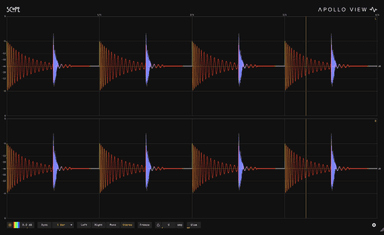
SCOPE
See the signal
Worth saying plainly: Scope, the free one, got the performance, the polish and the reliability work too. The long-window CPU win, the lighter rendering, the consistent sliders, the brighter labels, the state-persistence fixes - all of it. It's L/R only and it leaves the FFT, sidechain, Delta and metering to DeltaScope - but it's a genuine instrument you can keep for free, not a teaser.
Try DeltaScope in full
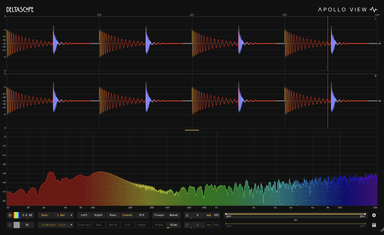
DELTASCOPE
See the difference
The other change worth flagging: DeltaScope now has a demo mode. Install it and it runs as the complete plugin - every feature, nothing held back - with a brief periodic interruption to the display and audio until you activate. The "DEMO MODE" banner is one click from activation whenever you decide.
So if you've been happily living in Scope and you've ever wondered whether the FFT, the sidechain Delta, the true-LUFS metering and the rest are worth it, you no longer have to take my word for it. Put DeltaScope on a real mix, in your own session, and hear it for yourself. That's the line I want between the two: Scope is a genuine, free oscilloscope you can keep forever - DeltaScope is the measurement bench, and now you can take it for a test drive before you commit.
What's next?
1.0 isn't an ending, it's the first version I'm fully proud of. I'm looking at an Audio timebase mode next - locking the scope window to the pitch of the signal itself, no MIDI routing required - and there's always another layer of performance to shave for the people running these on older machines. As ever: load them up, kick the tyres, and tell me what's missing.